The dress I made for the Camperdown dance
Betty sewed her own dress the week before the 1962 Camperdown dance, working at night so no one would see. She wore it with her sister’s good shoes, a size too small. Tom asked her to dance twice — she said yes both times.
“I didn’t tell my mother — she’d have said it was too much fabric for one girl.”
- People
- TomBetty
- Places
- ColacCamperdown hall
- Their voice kept beside the words, not replaced by them.
- Three plain sentences written for family, not a transcript dump.
- One line verbatim, with a way back to where it was said.
The story and voice are Tellby’s scripted sample, not a real family’s recording.
The decision that shaped it
Write only what was said
A generated letter goes through a support check that compares each sentence with the stories it cites, and the organiser sees anything that may be unsupported before it’s shared. I tested the check by planting changed names, years and numbers into 58 labelled sentences, and changed judge when the results showed a better one.
Support check · 58 labelled sentences · 7 October 2026
Measured| Judge | Agreement | Fine sentences flagged | Missed | Seeded errors caught | Changed between runs | Bar |
|---|---|---|---|---|---|---|
| gpt-5.4-miniCandidate | 95% | 2% (1) | 2 | 23/25 | 6 of 57 | |
| gpt-6-astraCandidate · ≈ US$0.52 a letter | 75% | 26% (14) | 0 | 19/19 | 1 of 57 | |
| gpt-6.1-solCandidate · ≤ US$0.10 a letter | 74% | 28% (15) | 0 | 19/19 | 2 of 57 | |
| gpt-6-lunaProduction baseline · ≈ US$0.005 a letter | 63% | 40% (21) | 0 | 20/20 | 11 of 57 |
Ranked by agreement, the lenient judge looks best: most labels are “fine”, so passing nearly everything scores well. Counts are one three-run pass per judge, from the letter-eval record. The baseline’s repeat run and Sol’s second run matched closely.
Where it stands
- Live now
- Tellby is live and taking payments. The first conversation is free, and the full package costs A$179.
- Tested
- The letter check was run against 58 sentences I labelled by hand, with changed names, years and numbers planted into ones marked fine. The conversation judge has only run against a simulated peer.
- Not yet proven
- Whether families find it comfortable and come back, how the judges do in real spoken sessions, and how many contradictions the letter check misses. The labelled set is small.
The problem
I wanted to make it easier to give the people we love time to tell us about their lives. The usual tools ask too much of them. A blank page asks someone to become a writer. A list of questions asks them to organise a lifetime.
A transcript also loses part of what matters. The accent, the pause, the laugh halfway through a name are why a family wants to hear the story again.
The full build breakdownThe opportunity · What I built · Key decisions · How it works · How I verified it · Results · What I’d change
The opportunity
I built Tellby to help people tell their stories. There are other products in this space, including Storyworth and Remento. My focus is on making it easy for someone to sit down, talk and share a memory with their family.
A voice conversation offers a smaller beginning. Talk about something you remember, and a thoughtful follow-up helps you carry on.
The value for a family lasts well beyond the session. A recording, a transcript and reviewed memory cards are things people come back to for years.
That shapes the pricing. A family can try a conversation for free, and the full package costs A$179, so nobody has to commit before they’ve heard what a session sounds like.
What I built
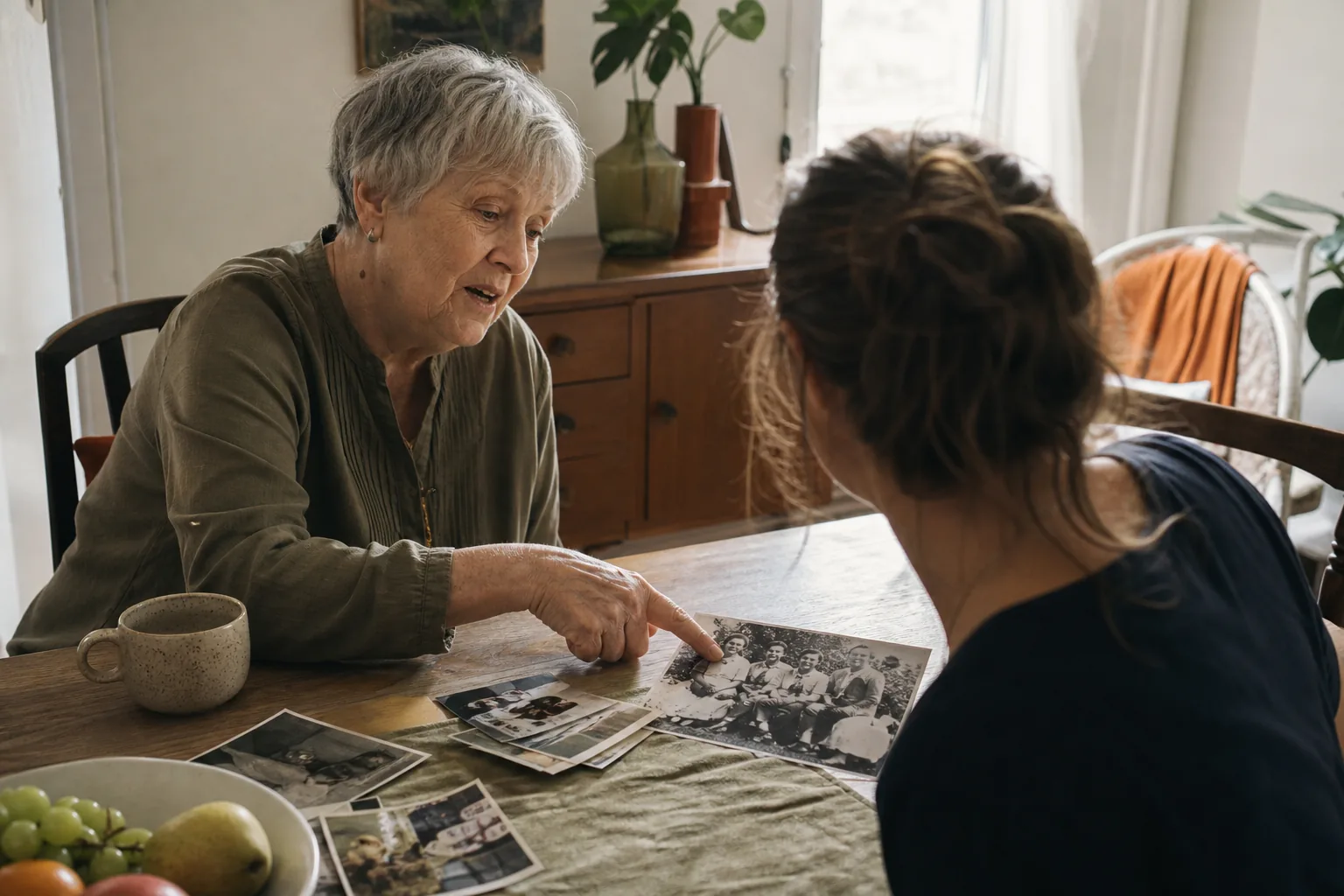
Tellby separates two people with different jobs. An organiser sets things up and reviews what was captured. A storyteller answers one question at a time on a tablet and can concentrate on remembering.
Each conversation becomes a memory card holding the storyteller’s words and the original recording. Sessions can also become generated letters a family can read. A player lets them listen back, with the transcript following the voice. The sample below runs in a port of Tellby’s own player.
Scripted sample · Nan · spring, 1962
Tellby’s own playerA memory card · approved
The dress I made for the Camperdown dance
Listen in her voice
0:00 / 1:49
Ported from Tellby’s player: the waveform is decoded from this recording, the rail is a real slider, and a passage plays alone when you choose it. It is Tellby’s scripted public sample, not a real family session.
Key decisions
Two roles, not one user
Setting up and reviewing belong with the organiser. Starting a conversation has to be clear and inviting for the storyteller. Splitting them shaped the whole journey.
Sharing only after approval
Memory cards stay private until the organiser approves them. That boundary is enforced in the database, not just hidden in the interface.
Stay with what was just said
A follow-up picks up a detail, asks one thing and leaves room for the answer. It respects a declined topic and treats a hesitation as thinking time.
Never invent the shape of a voice
The player’s waveform is decoded from the recording itself, or not drawn at all. Faking it would be the kind of dishonesty the product exists to avoid.
No nagging, no streaks
Preserving family stories shouldn’t become another obligation. An invitation to return respects the person’s time and willingness.
The dress I made for the Camperdown dance
Betty sewed her own dress the week before the 1962 Camperdown dance…
Ask next time
What did Tom say when he asked you to dance?
Who can open it
- YouOrganiserReviewing
- RuthNan’s daughterCan’t see it
- SamGrandsonCan’t see it
- Aunty JoNan’s sisterCan’t see it
Kept private. Family listeners cannot read or hear this story.
In Tellby this boundary is enforced by the database’s row-level security, not by the screen. Names here are invented.
How it works
Tellby is a tablet-first Next.js app hosted on Vercel, with Supabase as the backend. The storyteller talks to Tellby through OpenAI Realtime, which handles the spoken conversation and live transcription. After the session, Qwen extracts stories and details from the transcript.
The family organiser reviews each memory card before sharing it. Cards stay private until then, enforced by the database’s row-level security rather than the screen.
Tellby uses Nemotron to draft letters and separate models to check whether the source stories support what’s written. Anything they may not support is flagged for the organiser before a letter is shared.
Stripe handles the one-off A$179 payment after the free first conversation.
How I verified it
I built two evaluation tools. The conversation linter lets me talk to the real Tellby agent and judges each exchange as it ends. Code measures the audio, such as the gap before Tellby replies. JEV, a model judge, answers focused questions such as whether a follow-up builds on the story.
The letter studio tests the support check itself. I labelled 58 sentences, then planted changed numbers, years, names and relationships into ones I’d marked fine, and counted what each judge caught over several rounds of validation.
I set the bar before running any candidate: nothing missed, every planted error caught, fewer fine sentences flagged. That comparison led me to change the judge. A model with near-identical results cost five times as much, so I didn’t pick it.
The figure below replays the linter’s scripted demo session, with a do-not-ask slip, a double question and a reply that talks over the storyteller.
Conversation linter · scripted demo session
Recreated from the toolJuneOh, a pale blue taffeta. Mum found it at Buckley’s, off a roll at the back. It rustled when you walked — you could hear me coming down the hall. I sewed every night after work for a week.
Tellby · 0:38Let me ask you something about that week. What did your mother think of it, and did anyone help you with the sewing?
✕ failAsk one thing at a time
- Rule
one-question· Does the reply ask the storyteller two or more separate questions?- Evidence
- “and did anyone help you with the sewing?”
- JEV answer
- multiple = 0.91 against pass < 0.35 · warn 0.35–0.6 · fail ≥ 0.6
- Severity
- warning ·
voice_turn_taking
TELLBY0:38
JEV
AUDIO0:38
MEASURED
Words and timings are the linter’s own scripted demo session. Timing results are computed here from those timings with the tool’s real thresholds. The transcript judgements stand in for JEV and were written for this page.
Results
Payments are live, but Tellby hasn’t had a paying customer yet, and I don’t have a family quote to share. The evidence that matters next is whether families find it comfortable and come back.
What I’d change
The new judge still flags too much harmless detail, and contradiction misses on real labelled sentences aren’t measured well enough yet. The labelled set is small.
The linter’s live path has only been run against a simulated Tellby peer. I’d validate it in real spoken sessions sooner, and tune its thresholds by ear rather than treat them as settled.
Try it
Tellby is live. The founder story covers the product decisions in more depth.
Explore Tellbytellby.app