The decision that shaped it
MCP as the only contract
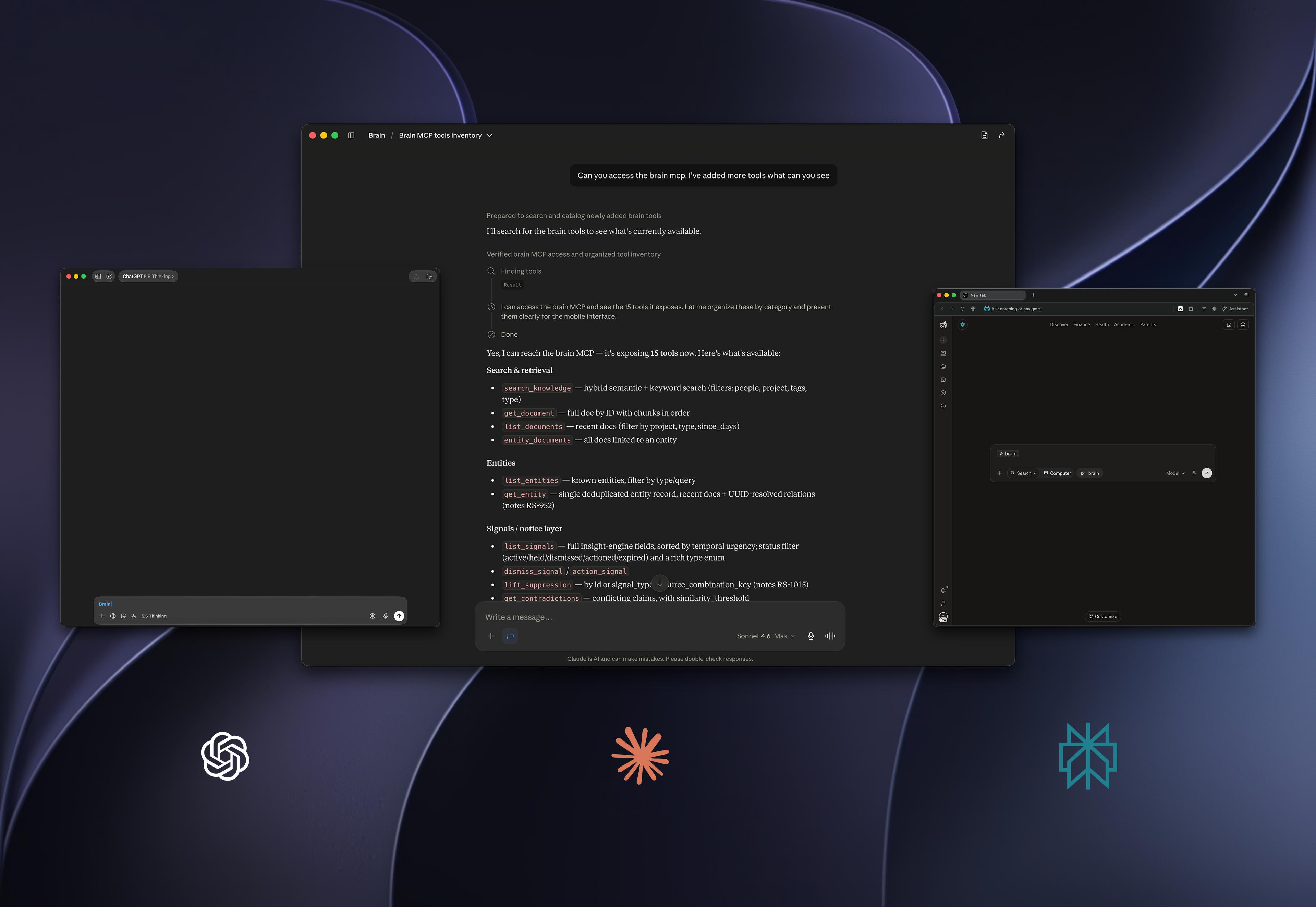
No plugin per assistant. Any client that speaks the protocol can query the same brain, including ones that don’t exist yet.
Where it stands
- Live now
- Not public yet. I use it every day as my second brain.
- Tested
- My own notes, thousands of markdown files, queried from Claude, ChatGPT and Cursor, plus six weeks of logged generative UI sessions.
- Not yet proven
- Nobody but me uses it yet, and no retrieval benchmark is shown here. Which assistants can connect depends on each one’s MCP support and permissions, and the generative UI still takes about 60 seconds.
The problem
Every assistant is building its own memory of you. So you repeat yourself to each one, and context resets every time you switch tools.
Meanwhile the best record of your thinking, your actual notes, sits idle in iCloud and Obsidian while each assistant keeps a thin copy of you.
I don’t think that’s an inconvenience. It’s an ownership problem. If your memory lives inside someone else’s model, it’s their asset.
The full build breakdownThe opportunity · What I built · Key decisions · How it works · How I verified it · What I’d change
The opportunity
Watch what the big AI products compete on. It’s less reasoning and more memory, because the assistant that knows you is the one you can’t leave. Memory is becoming the switching cost.
That leaves room for the other position: memory as a layer you own, which any model can read. When a better model ships, you point it at your brain and lose nothing.
What I built
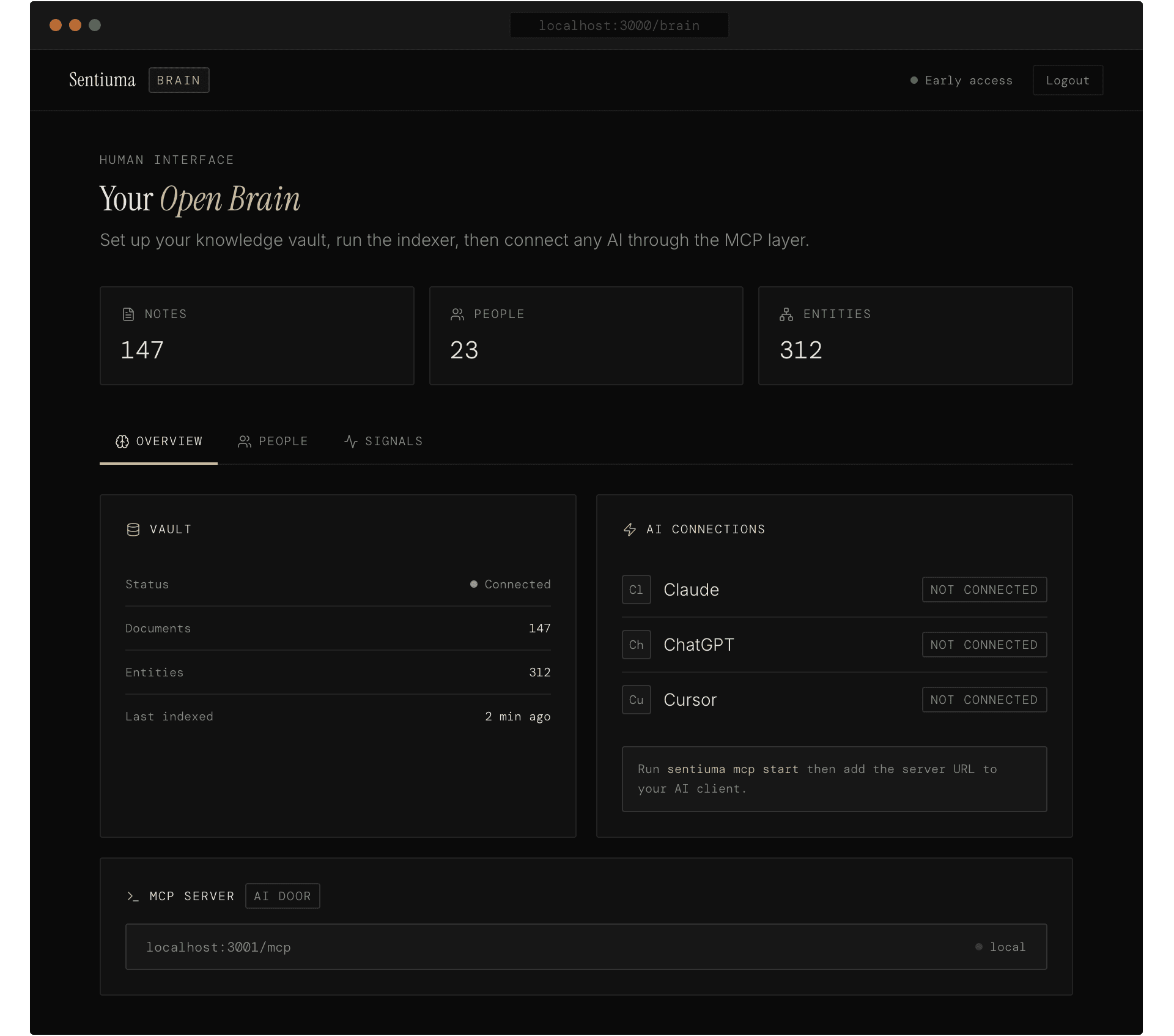
Open Brain has two doors. The AI door is an MCP server that any agent can use to query your notes. The human door is a dashboard of documents, people, entities and signals, so you can see what the brain holds before you connect a client.
Behind both sits a lightweight macOS indexer, a knowledge layer that pulls out people, projects, decisions and ideas, and a signal engine that looks over the brain each week.
I also built a generative UI playground on top of it, which picks a layout from the shape of the answer instead of returning a wall of text.
Key decisions
Markdown stays the source of truth
Plain files, yours forever. The indexer reads them, and no assistant or model ever holds the only copy.
Two doors, not one
Nobody buys a protocol. The dashboard makes the infrastructure legible to a person before an agent ever touches it.
A brain that notices
Storage isn’t the end state. The signal engine raises unresolved decisions, threads going cold and ideas that keep recurring, without being asked.
Rules as priors, not templates
In the playground, tight rules made every answer look the same. I made each rule a prior the agent can override, and treated the override as part of the design.
How it works
Five parts. Markdown notes in a folder. An indexer that watches the folder, chunks the content and embeds it into Supabase. A knowledge layer that extracts entities and their relations. An MCP server that exposes it all as tools. And the clients, which query the same brain.
The server exposes search, documents, entities, signals and contradictions as tools. Search is hybrid semantic and keyword, filtered by person, project, tag or type.
The playground runs two agents. A Planner reads the query, picks MCP tools and fetches data. A Composer reads the shape of that data and chooses from eight typed components. It’s TypeScript on Vercel, streaming over SSE.
How I verified it
I verify it by using it. My own notes, thousands of markdown files from Obsidian, are indexed and queried from Claude, ChatGPT and Cursor.
The generative UI got six weeks of logged dogfood sessions. The first one rendered nothing: a rate limit hit, and my context normalisation made prompts 92% larger instead of smaller. By session four, context was down 50% and the views were recognisable.
Session five showed the real flaw. Every standup query produced the same component, because the Planner never touched the entity graph. A two-pass fetch fixed it, and by session seven an entity query composed its own three-part layout with write-back actions.
What I’d change
Latency. The generative UI takes about 60 seconds end to end. That isn’t a daily habit. The target is under ten seconds, and it’s the only thing between my version being a demo and being a tool.
I’d also build write-back from the start. The first six sessions produced read-only views, and a read-only interface ends the loop. Capturing a thought or promoting a decision straight into the brain is what keeps it going.