The memory land grab
Watch what the big AI products are competing on. Not reasoning. Memory.
Each assistant wants to be the one that knows you, because the one that knows you is the one you cannot leave. Memory is the new switching cost.
The cost lands on you. You repeat yourself to every model. Context resets between tools. And the richest record of your thinking — your actual notes — sits idle in iCloud and Obsidian while each assistant builds its own thin copy of you.
The misconception is that this is just an inconvenience. It is an ownership problem. If your memory lives inside someone else's model, it is their asset, not yours.
Flip the model: one brain, every AI
Sentiuma inverts the relationship. Instead of every model building its own memory of you, you build one brain they all read from.
The architecture has five moving parts:
- Markdown stays the source of truth. Plain files, yours forever.
- An indexer — a lightweight macOS app — watches the folder, chunks and embeds content.
- A knowledge layer extracts people, projects, decisions, and ideas.
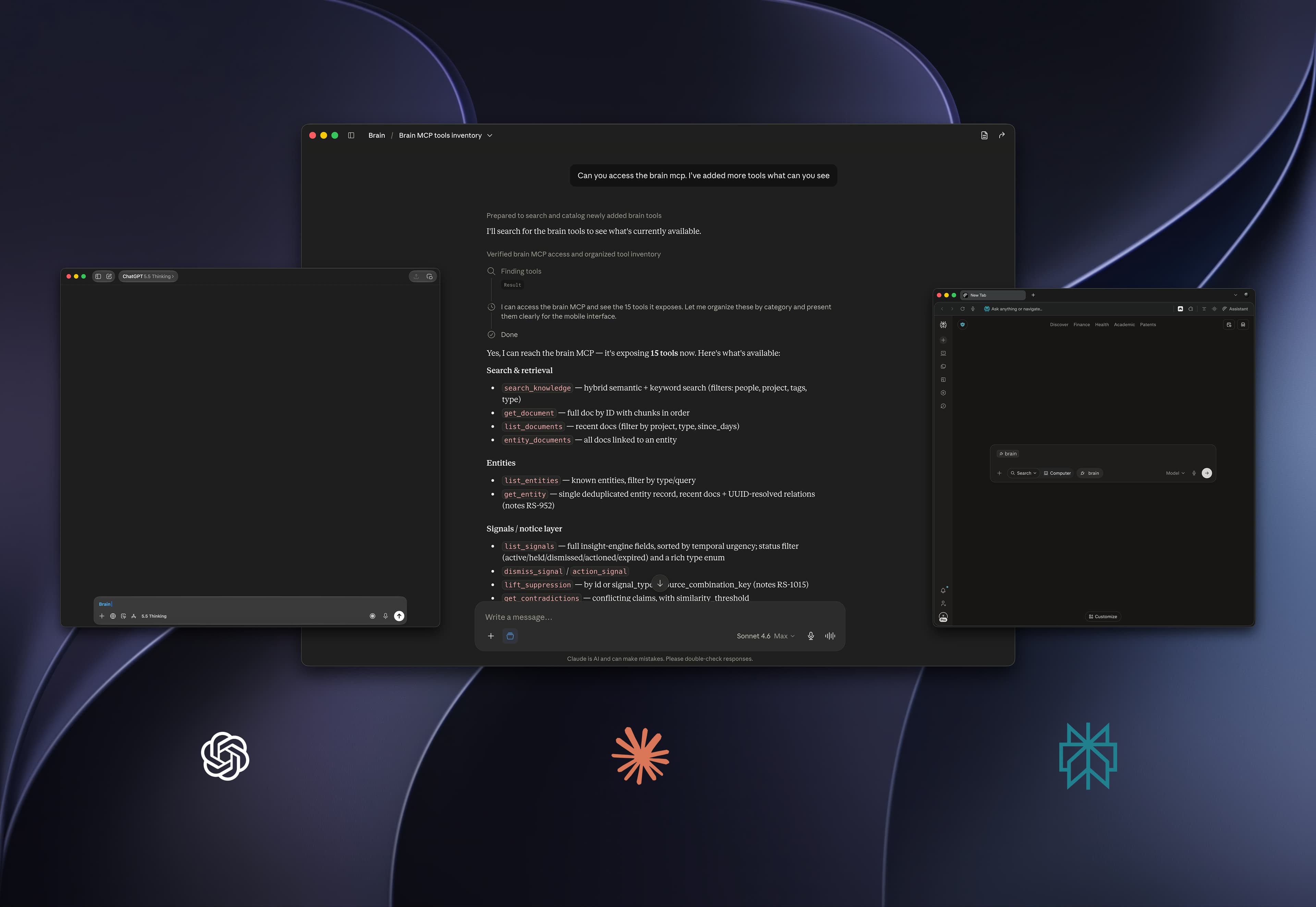
- An MCP server exposes that knowledge to any AI client that speaks the protocol.
- The clients — Claude, ChatGPT, Cursor, whatever comes next — query the same brain.
Write once, query anywhere. When a better model ships, you point it at your brain and lose nothing.
Designing two doors
Infrastructure has a design problem: it is invisible until it breaks. Nobody buys a protocol.
So the product has two doors. The AI door is MCP — the machine-readable contract that lets any agent query your notes. The human door is a dashboard showing documents, people, entities, and recent activity, so the value of the brain is legible before you ever connect a client.
The design work is making the architecture feel inevitable rather than technical. A calm visual language. Opinionated defaults. A position that takes itself seriously as infrastructure, not another chat app.
A brain that notices
Storage is not the end state. A pile of indexed notes is still a pile.
The signal engine gives the brain a surface of its own. Each week it raises what your notes know and you have stopped looking at: decisions left unresolved, threads going cold, the same idea recurring across months of captures.
That is the test I hold AI-native products to. Not "can it answer when asked" but "can it notice without being asked". Memory you own should work for you, not wait for you.
What this project is for
Sentiuma is the work I point to when someone asks what AI-native product design looks like in practice.
It is not screens around a model. It is choosing where the data lives, what the contract between human and agent looks like, and which side of the ownership line a product stands on.
If memory is the switching cost of the AI era, the practical implication for builders is simple: decide early whether you are building a silo or a layer. Users will eventually notice the difference.