The decision that shaped it
Their clock, never the device’s
Every time on the glass comes from the place’s IANA timezone, and the sun from its latitude, longitude and the moment in UTC. A fixed offset per place would be wrong for half the year. In October the gap between Melbourne and London changes twice in three weeks.
London
12:00pm
Tuesday 29 SeptemberBST
9 hours behind you
sun 35° up
Kuala Lumpur
7:00pm
Tuesday 29 SeptemberGMT+8
2 hours behind you
sun 1° up
Kolkata
4:30pm
Tuesday 29 SeptemberIST
4½ hours behind you
sun 12° up
Where it stands
- Live now
- Live at window.rsimms.com, built over a few days in November 2026.
- Tested
- Reviewed on a phone against a design skill, which changed the first screen and the line under the clock.
- Not yet proven
- Whether a glance replaces looking up the time and weather before a call. It hasn’t been tested with people yet.
The problem
My research kept turning up the same habit. Before a call to someone overseas, people check the time and the weather where that person is. The calendar has already settled when to call, so this isn’t logistics. They want a reference point. Are they just up? Is it dark there? Is it raining?
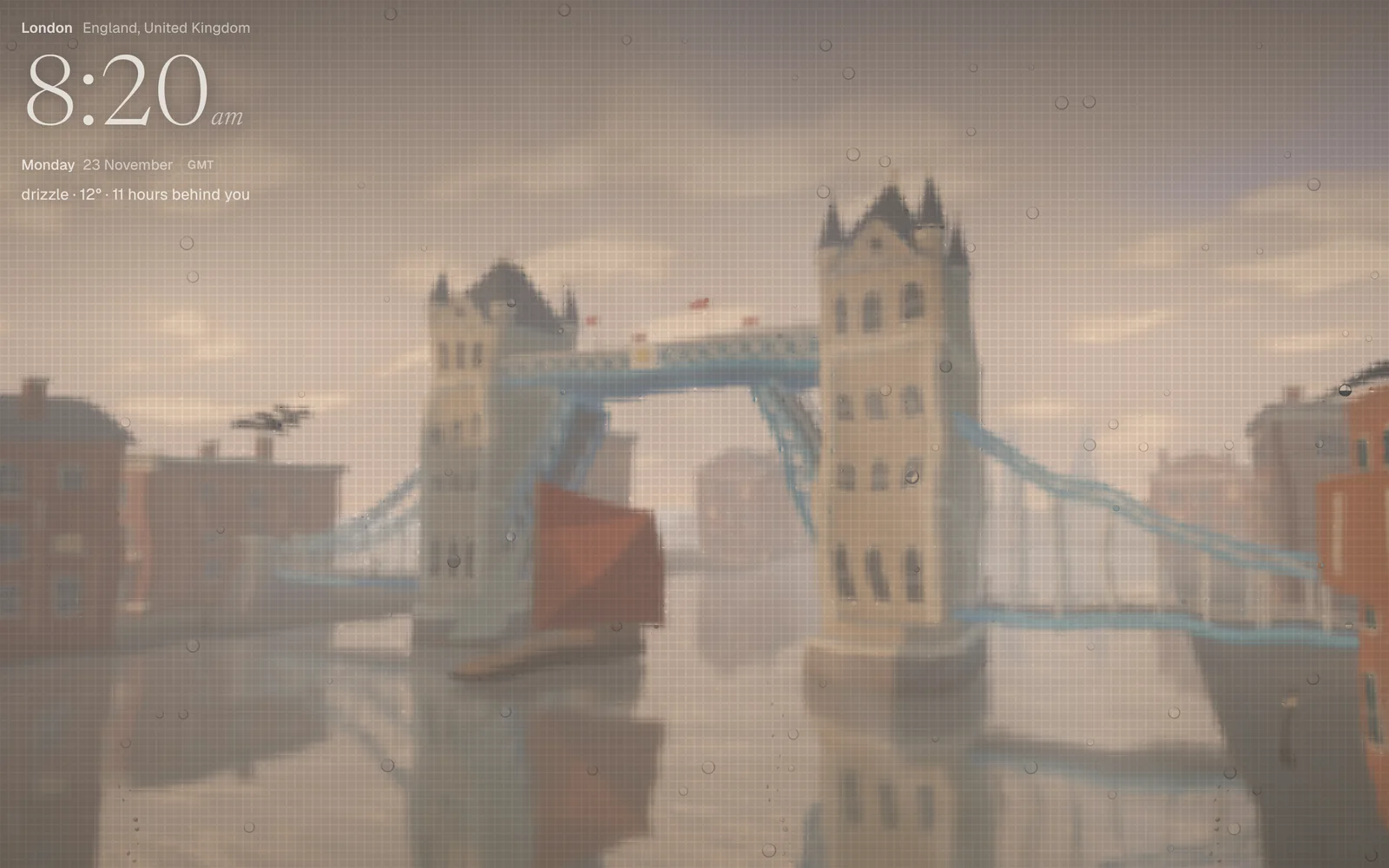
What they get back is 8:20 am, 12°, drizzle. The numbers are right, and the person is missing from them.
The full build breakdownThe opportunity · What I built · Key decisions · How it works · How I verified it · What I’d change
The opportunity
A world clock and a weather app already answer the questions. Nothing answers them together, as a scene, for a particular person.
What I built
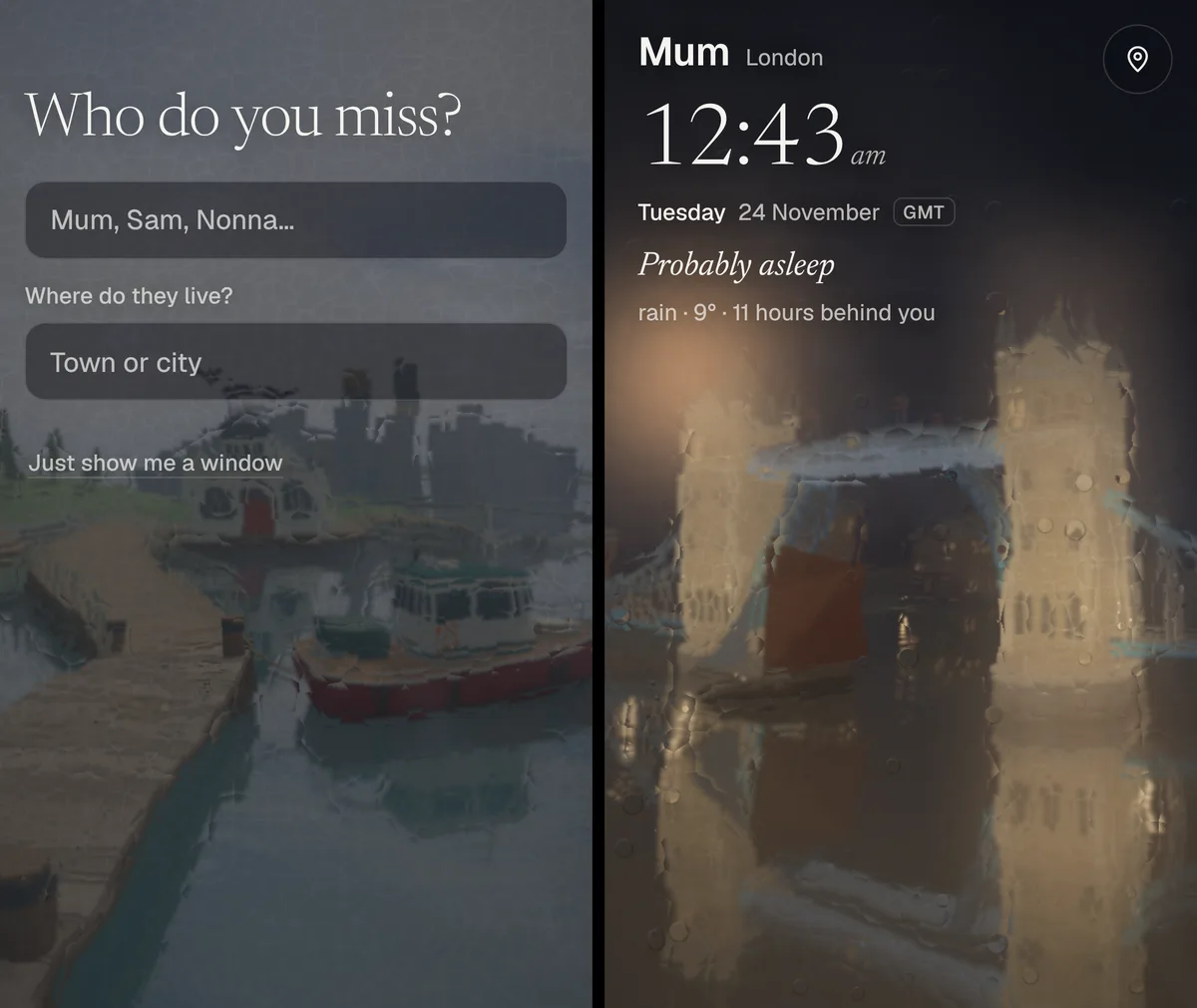
The first launch asks one question, “Who do you miss?”, and where they live. Their window opens first, with the name large and the town small. You swipe between a window for each person, and where you are becomes the reference for all of them, as in “11 hours behind you”.
London gets Tower Bridge, Melbourne St Kilda Pier and Kuala Lumpur the Petronas Towers. Anywhere else gets a garden that faces the equator and grows to suit the local climate. You can wipe the condensation with a finger, and now and then something happens: the bridge lifts for a sailing barge, or a shooting star crosses a clear night.
Places are saved on your device, Share makes a link that opens straight onto a window, and on a phone it installs as a full-screen web app.
Key decisions
Ask who, not where
An early version opened on my own city, the sky I could already see by looking up. A review against things Steve Jobs said on the record caught it, so the app now starts with the person you miss.
Describe their hour, don’t judge the call
One line under the date reads “Probably asleep”, “Just waking up” or “Evening there”. An earlier line said “a good time to call”. I took it out, so the judgement stays with you.
Spend detail where the glass is cleared
Through frost, silhouettes and lit windows carry the view, so the scenes are low-poly. The detail went where people look once they wipe the pane: coursed stone on the towers, satin paint on the girders.
One way to clear the glass
An eye button used to clear it too. I removed it and let a fingertip streak wipe itself and fog back over on first open, so the gesture teaches itself without a label.
How it works
It’s a Next.js app with a Three.js scene behind a glass shader pass. The pass samples the view through a grid of irregular lenses, then adds condensation, frost in the cold, rain on the pane and the mask your finger wipes. The lenses are larger on touch screens, 14 pixels instead of 9, because a fine grid read as a screen door on a phone.
Time and daylight are worked out per place. Clocks and zone names come from the IANA timezone, and the sun position from NOAA’s formulae. Weather comes from Open-Meteo in one request for every saved place, every 10 minutes. The garden also reads the last 30 days of rain and temperature, so Lagos grows lush and Oslo goes dormant.
Your own city comes from Vercel’s edge geo headers, so no third party sees your IP address and nothing asks for location permission. The rare moments come from seeded time slots, so the same moment looks the same on every load. With reduced motion on, the scene’s clock stops.
Drag through October to watch the gap between two cities move. The demo runs the app’s own time and sun code.
How I verified it
I reviewed the app on a phone against a skill I’d built from Make Something Wonderful, the Steve Jobs Archive’s book of his speeches and emails. That review changed the first screen and the line under the clock.
I haven’t yet tested it against the habit it answers. The next study is to put Far Window in front of people before a real call and see whether a glance replaces the look-up.
What I’d change
It shows the weather now, not later. Only three cities have their own scene, and windows live on one device, so a family can’t share a set yet.
The line under the clock reads the hour, not the person. Someone on night shifts still shows as “Probably asleep” at 3 am. And the landmark pipeline is built by hand, which I’d revisit before adding many more cities.
Try it
Open it, tell it who you miss, and wipe the glass.
Open Far Windowwindow.rsimms.com