Seven brands, one deadline
I joined at the start of the engagement in late August 2017 and met a product owner holding a bucket list of features and a 30 June 2018 deadline.
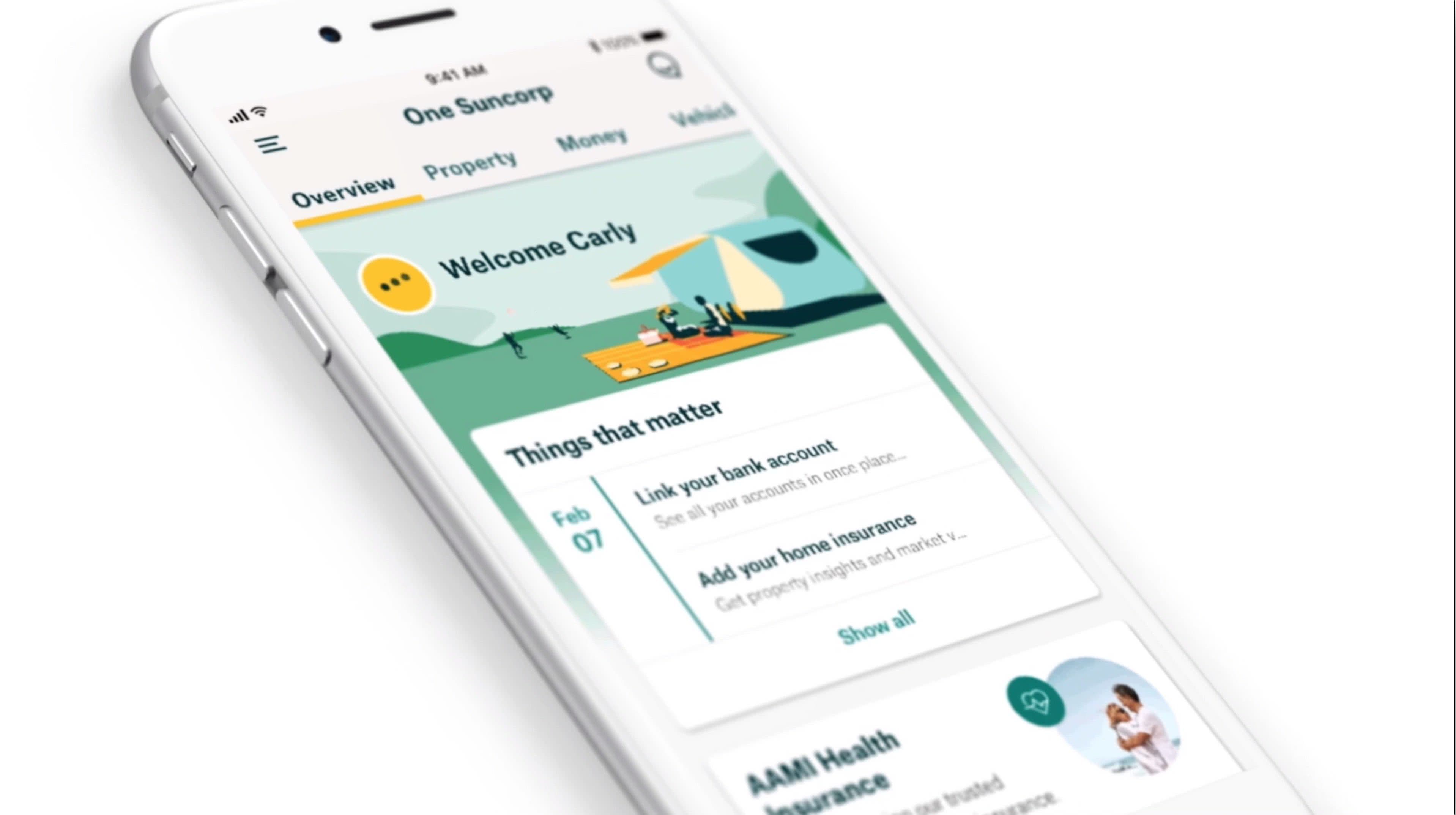
The ambition was clear: one place for customers to see, store, and do everything across their money, home, car, and life — a single destination replacing seven separate brand apps.
The shape of the risk was just as clear. With that many brands, features, and teams, the project would not fail on any one screen. It would fail in the seams between them.
Discovery on two tracks
We ran the project dual track, and I led the discovery phase: workshops, customer interviews, concept experiments.
One of the first battlegrounds was navigation — standard patterns versus custom — and a registration flow that had to accept credentials from seven different brands without feeling like seven different apps. Throughout, we tested everything with customers: the value proposition, the navigation concepts, the desirability of individual features.
Discovery wasn't a phase that ended. It ran ahead of delivery the whole way, feeding validated decisions to teams that could not afford to wait.
The app map: one artefact to align everyone
To show how every feature would connect and be reached, I worked with the product owner and technical architects to design the information architecture as an app map — the core pillars of the app and how the features hang together, on one surface.
It became the project's common language. Senior leadership saw the same picture the development pods built from. My monthly contribution to their leadership updates — user-testing summaries and prototypes of key experiences — hung off that shared structure.
On large programmes, whoever holds the clearest picture of the whole holds the project together. Make that picture an artefact, not a memory.
Holding consistency across three states
As development scaled to seven pods across three states — each building iOS and Android natively — I pivoted from discovery to wire flows: screens linked by interactions and states, ready for build. I worked across features from categorised transaction banking to the overview and property sections, finalising interactions with the product owners and technical architects, and mapping existing APIs to features or requesting new data where services didn't exist yet.
With the vision set, my job became consistency. Alongside the UI lead, we ran standing checkpoints — peer crits, design reviews with the client, showcases — so seven pods' output still read as one product.
What shipped
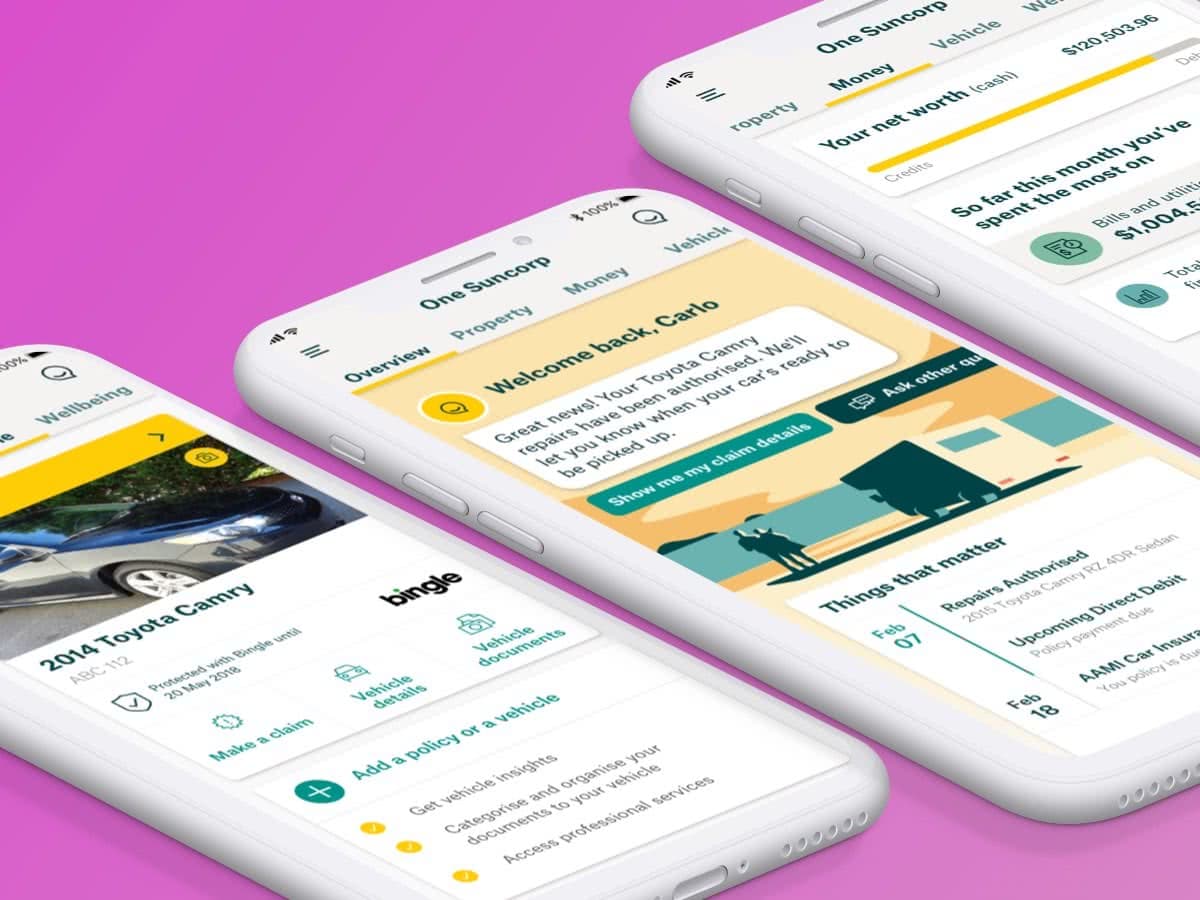
The iOS and Android apps launched with fast, secure access to bank accounts: categorised transactions, transfers, bills, and payments. Customers could self-serve across car, home, and life insurance — update an address, pay a renewal, get a quote — and lodge a claim, then track it from start to finish. A virtual assistant answered questions about specific accounts and policies.
The lesson I took into every multi-team programme since: scale doesn't multiply design work, it changes its kind. Past a certain size, the highest-leverage design is the structure everyone else designs inside.