The list is the problem
An infinite task list makes a quiet promise: everything you add will get done. It will not, and you know it will not, so the list becomes a ledger of debt instead of a plan.
That is why task apps feel worse the longer you use them. The backlog is not a capacity problem. It is an emotional one. No amount of better sorting fixes a list whose job is to remind you of everything you have not done.
Tools keep optimising input. The cost has always been at the other end — there is no moment where the day is allowed to finish.
Three tasks, no fourth slot
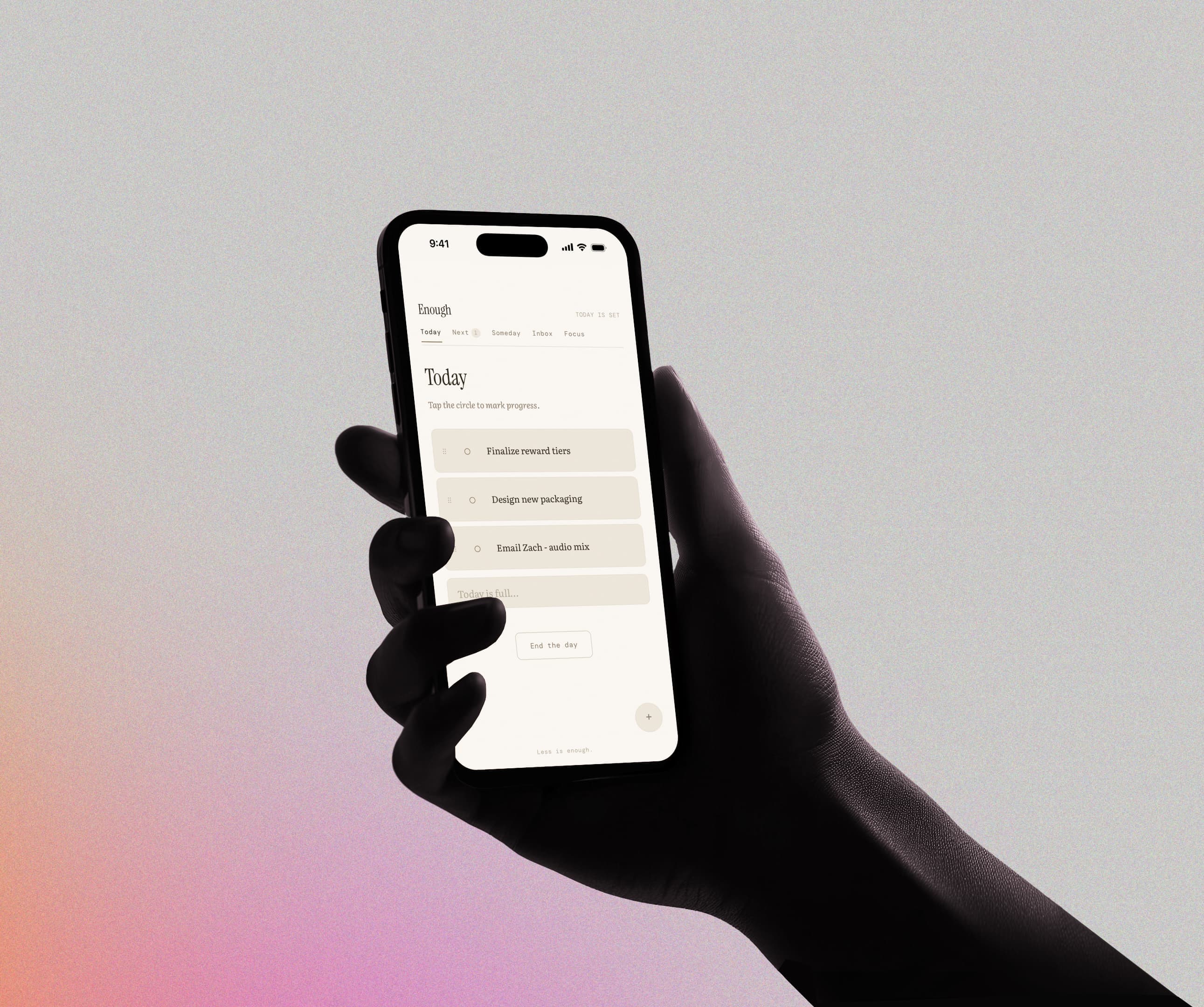
Enough is built around one rule: three tasks only.
There is no fourth slot. When all three are filled, the add action disappears. Not disabled with a tooltip explaining premium plans — gone.
The constraint forces the decision that infinite lists let you defer forever: what matters today? Choosing three things is a plan. Choosing thirty is a wish.
Unfinished is not failed
Most apps treat an unfinished task as a small failure that rolls over and accuses you tomorrow.
Enough parks unfinished work into quieter spaces — Next or Someday. Nothing is deleted, nothing nags. The work keeps its place without carrying its guilt forward.
The distinction sounds soft, but it changes how the tool feels to return to. You open it to decide, not to be reminded.
Closing the day is a feature
At the end of the day, a deliberate close ritual shifts the interface into an evening palette and confirms one thing: nothing was forgotten.
That confirmation is the entire product. Not optimisation. Closure.
Knowledge work removed the natural end of the working day, and software never replaced it. A factory whistle was an interface. Enough is an attempt to design one for people whose work never visibly finishes.
What designing for "stop" taught me
Restraint is a feature you have to build, not a feature you get by leaving things out.
Every screen in Enough is warm and quiet on purpose — soft type, generous spacing, fewer choices, no settings to tend. The interface signals that stopping is a skill, not a failure.
The wider lesson for anyone building products: look at what your category measures, then look at what your users feel. Where those two diverge is usually where the real product is.