A market quietly looking for the exit
The numbers behind the brief: 78% of workers feel disengaged, and 40% are actively considering a career switch.
That is an enormous audience SEEK's core product barely served. Job search assumes you know what you're looking for. Career changers, by definition, don't yet.
Our team was deliberately small — myself as Product Designer, Jack as Product Manager, Ahmed as Engineer — and we worked rapid and data-driven: continuous customer interviews and surveys, with an Opportunity Solution Tree to map journey stages to solution ideas.
Four phases, not one question
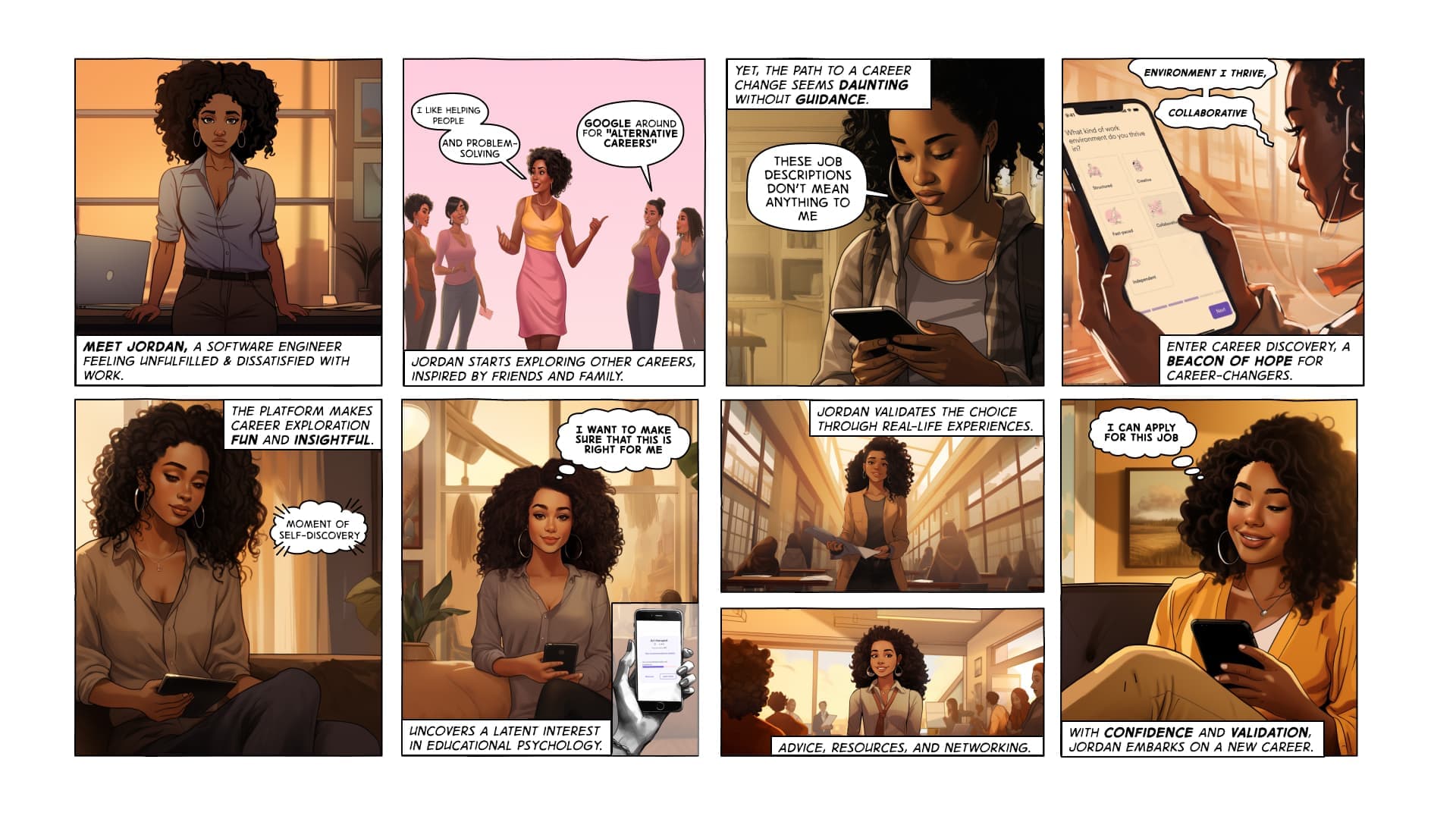
The research kept surfacing the same shape. Career changers move through four phases: dissatisfaction, exploration, evaluation, and action.
Each phase asks a different question of a product. Dissatisfaction needs validation that the feeling is real. Exploration needs breadth without overwhelm. Evaluation needs honest comparison. Action needs a concrete next step.
A traditional quiz collapses all four into one transaction — which is why people finish them, feel briefly entertained, and change nothing. We designed for the phase the user was in.
Using AI for relevance, not theatre
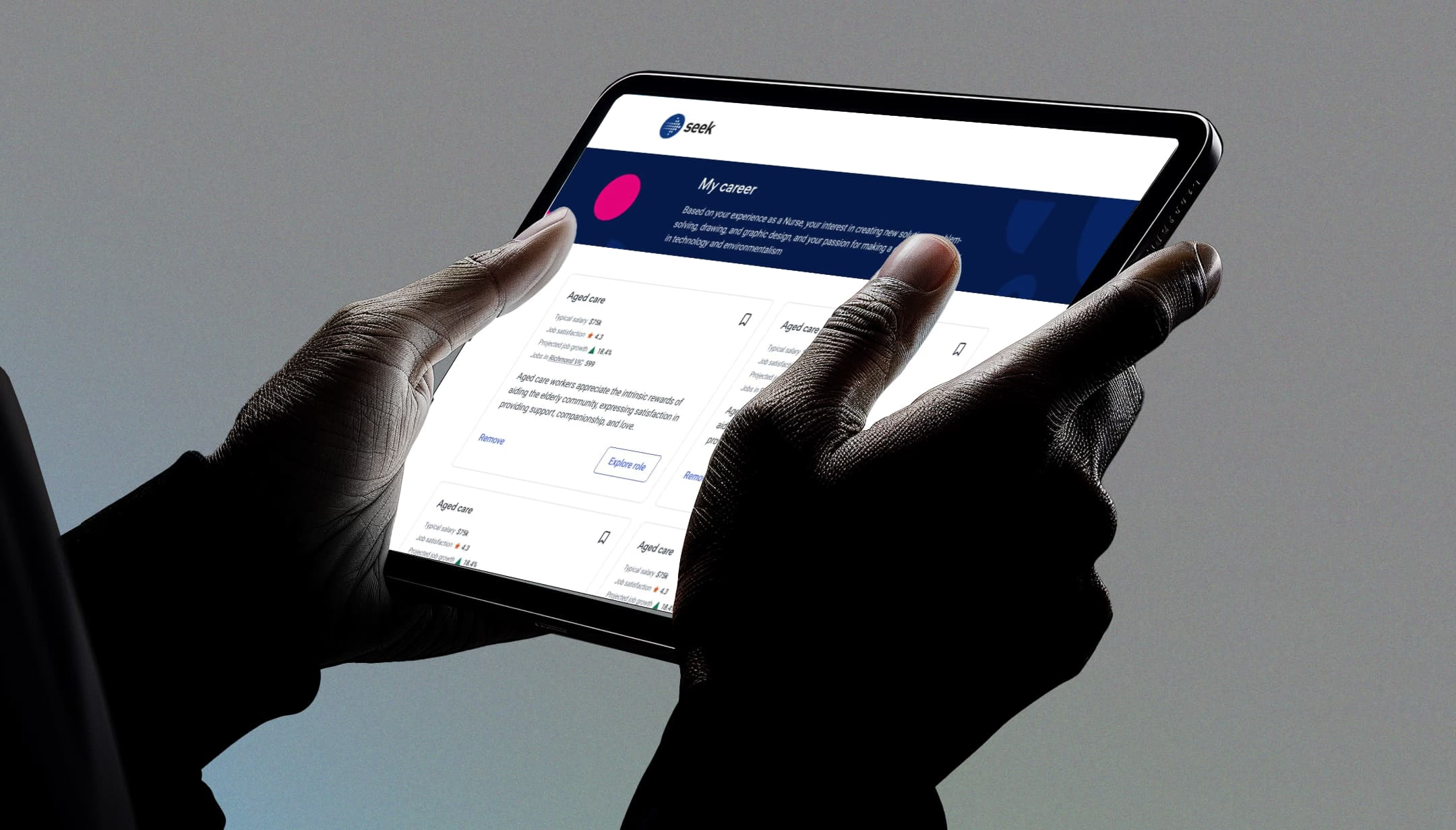
The AI in Career Compass isn't a chat personality. We used OpenAI's LLM with few-shot learning and embeddings, plus vector search, to match quiz responses with detailed role insights — recommendations grounded in real roles rather than personality archetypes.
The model's job was precision of fit. The design's job was building enough confidence to act on it. I worked closely with our engineer on a quiz experience with custom interactive elements that made completion enjoyable, while meeting Responsible AI standards and integrating with SEEK's core platform.
Users called the result "an eye-opener" — not because the AI was visible, but because the recommendations felt like them.
Measuring confidence, not clicks
We tracked the product with the HEART framework — Happiness, Engagement, Adoption, Retention, Task Success — so emotional outcomes had the same standing as funnel metrics.
The results: 26.2% of users clicked directly through to recommended roles, and 38.3% reached role pages directly or indirectly — beating the 33% target we had set for that combined journey. Positive sentiment hit 74% against a 35% target.
The takeaway for anyone building guidance products, AI or otherwise: find out what journey your user is on before you optimise the answer. The model can rank roles. Only the design can make someone believe a change is possible.