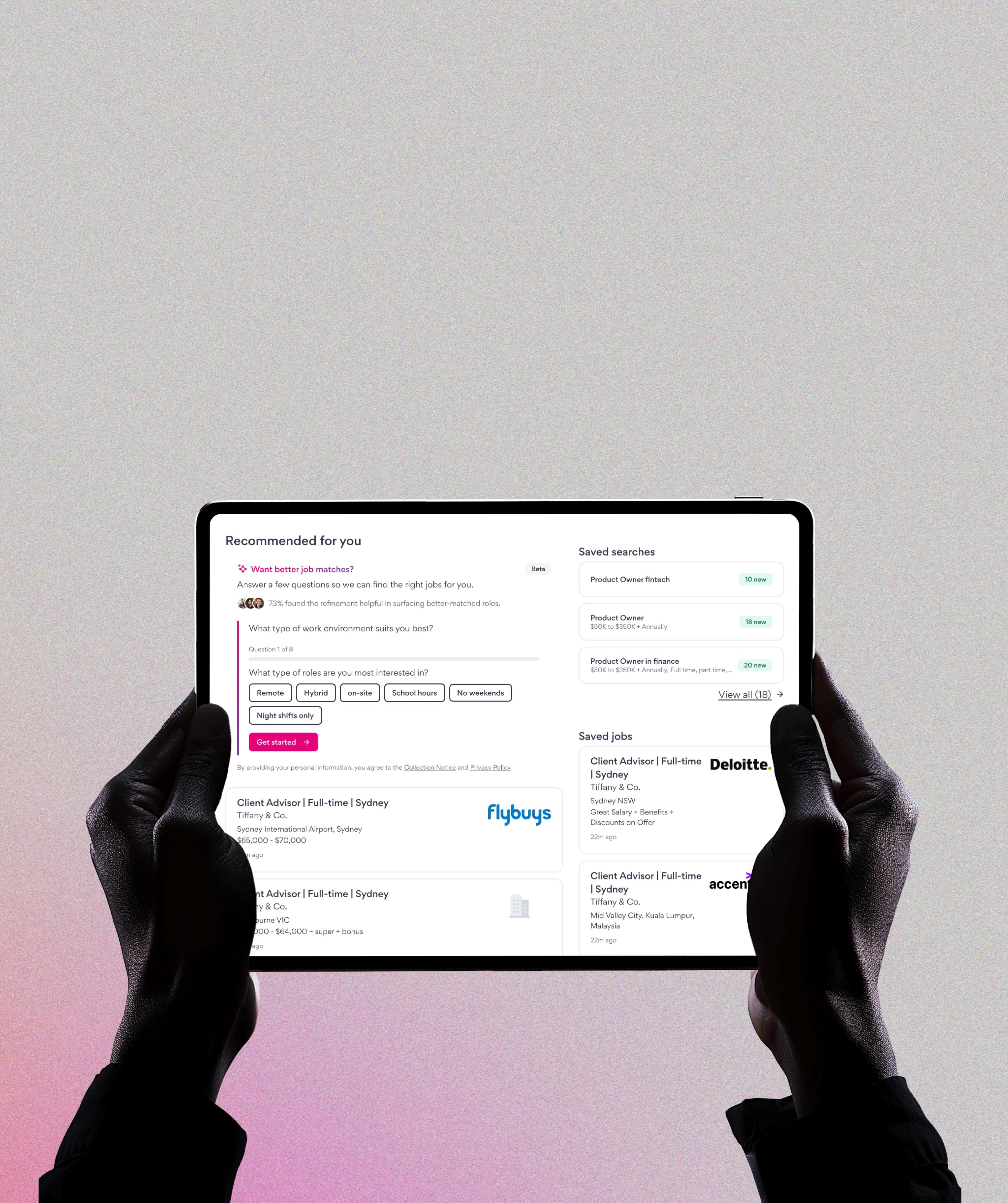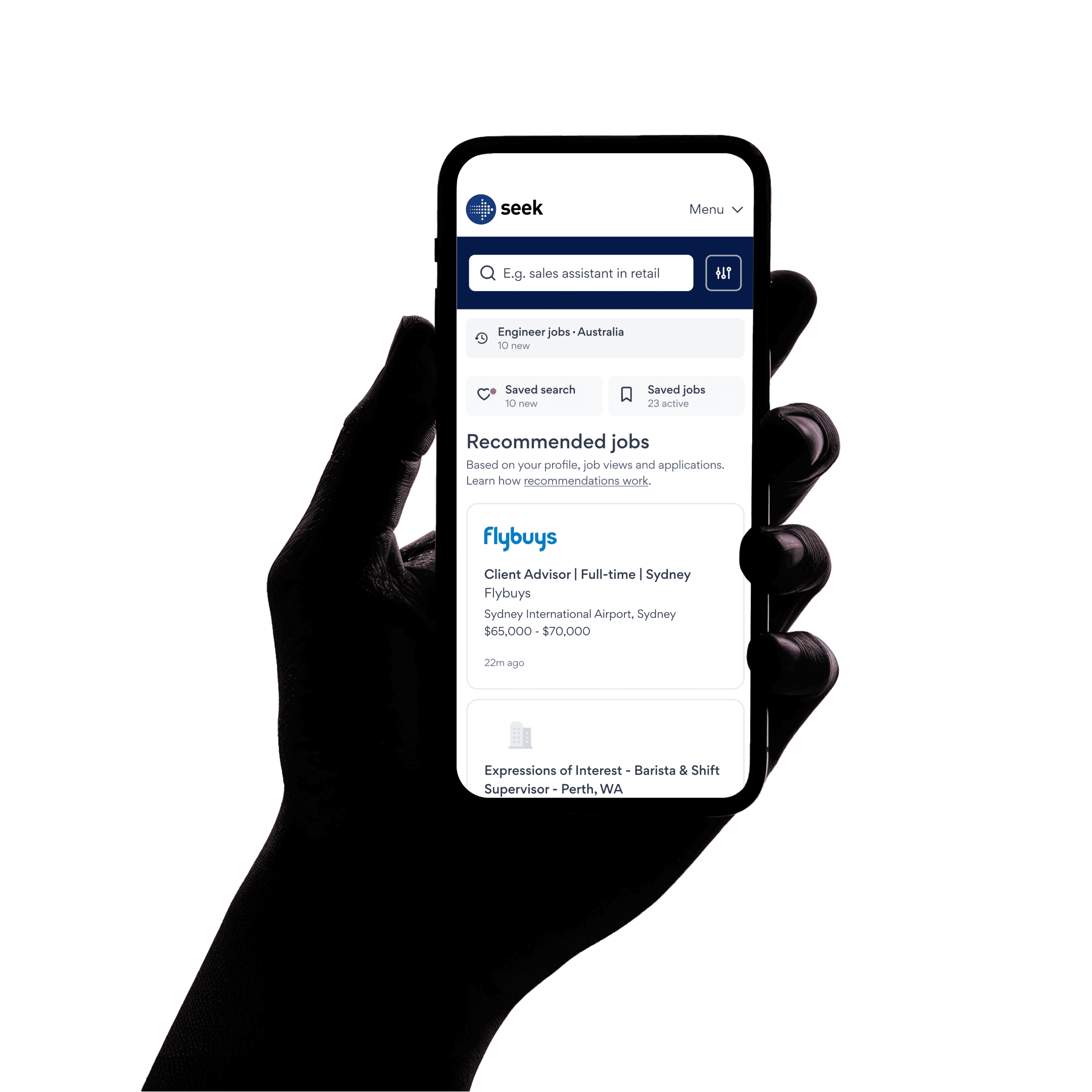

Nine items at the front door
The homepage is where jobseekers decide, in seconds, whether SEEK has something for them today. The three-column layout answered that question with a shallow sample: three jobs, three saved searches, three saved jobs.
The hypothesis was direct: an expanded list of 50 recommended jobs, optimised on user profiles and search behaviour, would lift engagement, satisfaction, and application rates.
We defined the targets up front: increase Job Detail Views and Apply Starts, lift satisfaction as measured by SUPR-Q and NPS, and shorten time to job discovery — a driver of placements, retention, and growth.
An experiment, not a launch
Working cross-functionally with a product manager, data scientists, and engineers, we treated the redesign as a structured experiment rather than a reveal:
- hypothesis testing across layout variations
- user behaviour analysis across markets
- performance tracking with defined metrics and guardrails
- qualitative research to validate the design decisions underneath the numbers
The design itself focused on making depth navigable — an intuitive layout with interactive elements, and a feed whose relevance justified its length.
Two kinds of evidence
Quantitative and qualitative methods answered different questions, and we needed both.
I ran a SUPR-Q survey comparing satisfaction on the new homepage against the search results page across markets — eight questions covering usability, trust, appearance, and loyalty. Alongside it, I interviewed 12 jobseekers in depth before and after the redesign, combining concept validation with story-based interviews, and documented behaviour through session recordings.
Then we launched the A/B test with structured statistical planning. The numbers told us the feed won. The interviews told us why — and surfaced what the numbers hid.
What the interviews caught that the A/B test missed
The redesign validated the hypothesis. Job discovery got roughly 40% faster, and engagement, Apply Starts, and satisfaction gained alongside it. The eight-question SUPR-Q survey, run against the search results page across markets, averaged 6.49 — the benchmark every homepage iteration since gets measured against.
But the interviews surfaced what no dashboard flagged: usability problems in specific flows, and a recommendation freshness problem — users noticing the same jobs reappearing, which quietly erodes trust in the whole feed. The rollout proceeded in phases across markets, with mobile improvements and algorithm freshness prioritised from those findings.
The lesson is the one the old layout got wrong: when relevance is high, users want far more than tidy design instincts suggest. Respect their appetite — and keep talking to them, because the winning variant of an A/B test still has things wrong with it that only users will tell you.